
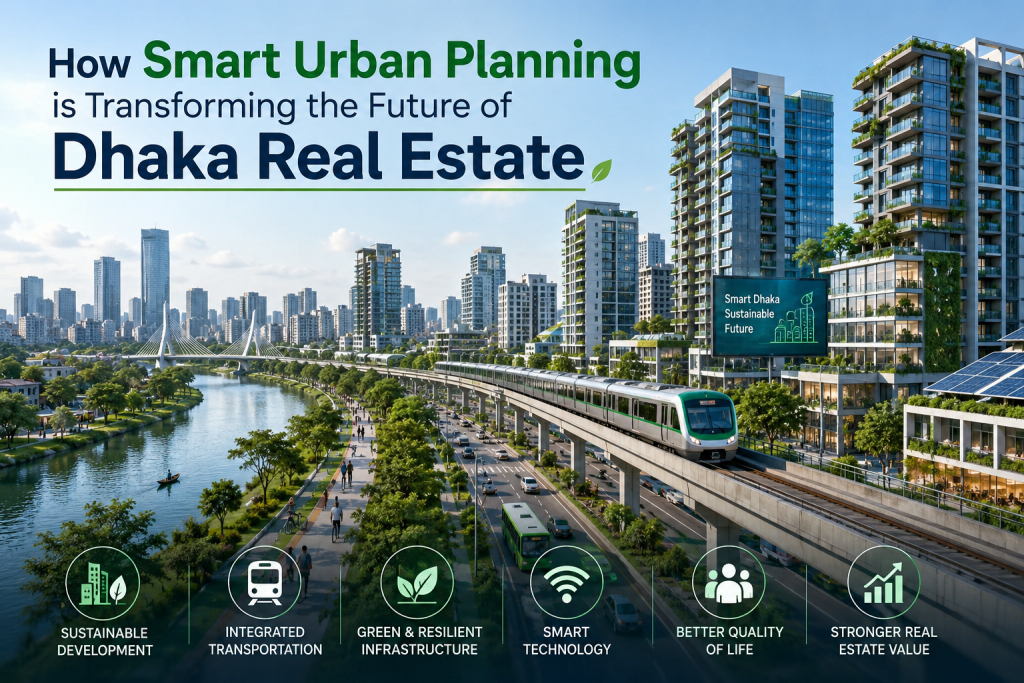
Dhaka is one of the most densely populated cities in the world. For decades, the city grew without a clear plan. Roads became congested, buildings went up without proper approval, and infrastructure struggled to keep up with demand. That is changing. Government bodies, urban planners, and private developers are now working together to reshape how Dhaka grows.
Smart urban planning is bringing new roads, better transit, planned residential zones, and modern infrastructure to the city. This guide delves into how smart urban planning is transforming the future of Dhaka real estate.
What Smart Urban Planning Actually Means for Dhaka
Smart urban planning means building a city with a clear set of rules. It decides where homes, businesses, roads, and green spaces go. The top real estate company in Bangladesh is already working within this framework, aligning its projects with official zoning guidelines to offer buyers stronger legal standing and lower investment risk.
For most of its history, Dhaka grew without such a structure; the city has always been under some form of formal planning since its first master plan in 1959. But most of those plans failed to keep up with the city’s rapid growth.
That changed in a meaningful way when RAJUK introduced the Detailed Area Plan, known as the DAP. The current DAP covers the period 2016 to 2035 and was formally adopted in 2022. It is a statutory planning and land use policy that regulates how every parcel of land within the Dhaka metropolitan region can be used and developed.
The DAP covers approximately 1,528 square kilometres, including Dhaka, Narayanganj, Gazipur, Savar, and Keraniganj. This means planning decisions now extend well beyond central Dhaka.
In simple terms, smart urban planning gives Dhaka a framework it has long needed. For anyone buying property in the city, understanding that framework is the first step to making a safer investment decision.
Key Projects Reshaping Dhaka’s Urban Landscape
Several major infrastructure projects are actively changing where people want to live and invest in Dhaka. Every serious real estate company in Dhaka is now factoring these projects into how they plan and position new developments.
- Dhaka Metrol Rail (MRT)
MRT Line 6 connects Uttara North to Motijheel and has already improved daily commutes across the city. The impact on property values has been immediate. In areas like Uttara, Mirpur, and Agargaon, land and apartment prices have increased as metro access has made these locations significantly more attractive to buyers and investors.
- Elevated Expressway
The Elevated Expressway is doing something similar on the other side of the city. It links the airport all the way to Tejgaon, and the areas along that corridor, Banani, Mohakhali, and Tejgaon, are seeing real demand as a result.
- Purbachal New Town
Purbachal New Town is the country’s largest planned township and first “Smart City, is home to major national projects. Land prices in the area have already doubled over the past five years. It represents one of the clearest examples of how planned urban development creates long-term real estate value.
- Dhaka Ashulia Expressway
The Dhaka Ashulia Elevated Expressway is expected to significantly improve accessibility to Savar, reducing travel time to Dhaka and driving demand for both residential and commercial land in the area.
Each of these projects is doing the same thing: making previously undervalued areas more accessible, more desirable, and more valuable. For buyers, understanding where these infrastructure lines run is now as important as understanding the property itself.
How Infrastructure Growth is Shifting Property Values
Infrastructure investment does not just improve a city., it redistributes value across it. As Dhaka’s major projects move from proposal to completion, money is flowing into areas that were previously overlooked by serious buyers.
The shift is most visible in land pricing. Zones that sit within the DAP boundary but were historically undervalued are now attracting developer attention precisely because planned infrastructure makes them viable for long-term residential and commercial use. Legal clarity from the DAP, combined with physical connectivity from new transit routes, drives sustained price growth.
Buyer behavior is also changing. Purchasers are increasingly making decisions based on future infrastructure access rather than current conditions. This forward pricing effect means that waiting for a project to fully complete before buying often means the value-gain has already happened.
This is where luxury apartments in Dhaka are seeing the strongest momentum. High-end developers are acquiring land in infrastructure-adjacent zones now and building projects that will deliver two to three years from today, when connectivity is fully operational and demand peaks. Buyers who enter at the pre-launch stage in these corridors are effectively purchasing against confirmed infrastructure rather than speculation.
What Smart Urban Planning Means for Buyers and Investors Today
For buyers, smart urban planning has made Dhaka’s property market better than it has ever been. The DAP, RAJUK zoning rules, and confirmed infrastructure pathways give investors a clear basis for decision-making that did not exist a decade ago.
The risk profile of buying in Dhaka has shifted. DAP-compliant projects carry stronger legal standing, lower approval risk, and better resale potential. Buyers who prioritize compliance over price alone are making structurally better investments.
For investors, the opportunity is in timing. Infrastructure confirmed zones are repricing now, before projects fully complete. Entry at this stage delivers stronger returns than buying into an already established market.
The bigger picture is simple. Dhaka is no longer a city where real estate decisions are made on instinct. Planning frameworks, transit maps, and zoning boundaries are now the tools every serious buyer needs to use.
Challenges That Still Need to Be Addressed
Dhaka has made real progress. But anyone looking at an apartment for sale in Dhaka should also understand the challenges that still affect the market. Planning and infrastructure improvements are moving forward, but several problems remain unsolved.
- Unplanned older areas: Large parts of central Dhaka were built before the DAP existed. Rebuilding these zones with modern infrastructure is slow, costly, and complicated.
- Waterlogging and flooding: Poor drainage remains a serious issue in many parts of the city. It affects living and long-term property value in low-lying areas.
- Utility gaps: Reliable gas, water, and electricity supply is still inconsistent across many residential zones, including some newer developments.
- Approval delays: Even DAP-compliant projects can face long processing times at RAJUK, which slows delivery and increases costs for developers and buyers.
- Rapid population pressure: Dhaka’s population continues to grow faster than infrastructure can keep up with, putting strain on roads, transit, and public services.
These challenges do not cancel out the progress being made. But they are real factors that affect where and what you buy. A well-located, DAP-compliant project in a planned zone will always carry less exposure to these risks than an unplanned or older development.
Final Thoughts
Smart urban planning is no longer a future promise for Dhaka. It is actively reshaping where people buy, what they pay, and how confidently they invest. The DAP framework, MRT expansion, and planned townships are turning an historically unstructured market into one with clear rules and real direction.
For buyers and investors, that shift creates genuine opportunity. But it also raises the bar. Understanding the planning framework is now as important as understanding the property itself.
FAQs
- What does smart urban planning mean for Dhaka?
It means the city now has rules for how and where it grows. Roads, housing zones, and public spaces are being developed with a long term plan instead of randomly. That makes Dhaka a more stable place to buy property.
- What is the DAP and why does it matter for property buyers?
The DAP, or Detailed Area Plan, is a statutory planning policy covering the Dhaka metropolitan region from 2016 to 2035. It matters because it gives properties in compliant zones stronger legal standing, lower approval risk, and better resale potential.
- What should I check before buying an apartment in Dhaka?
Prioritize DAP compliance, proximity to confirmed infrastructure like MRT stations or expressway access, and developer track record. These three factors now have the most direct impact on long-term value and resale potential.
- How is infrastructure investment connected to property prices in Dhaka?
Confirmed infrastructure reduces commute times and increases an area’s liveability, which drives buyer demand and pushes prices up. In Dhaka, this effect is already visible in zones served by MRT Line 6 and the Elevated Expressway.
- Is Dhaka a good place to invest in property right now?
Yes, especially in planned zones with metro access. The city has clearer development rules than it has had before, and infrastructure projects are actively pushing prices up in key areas.




Leave a Reply