
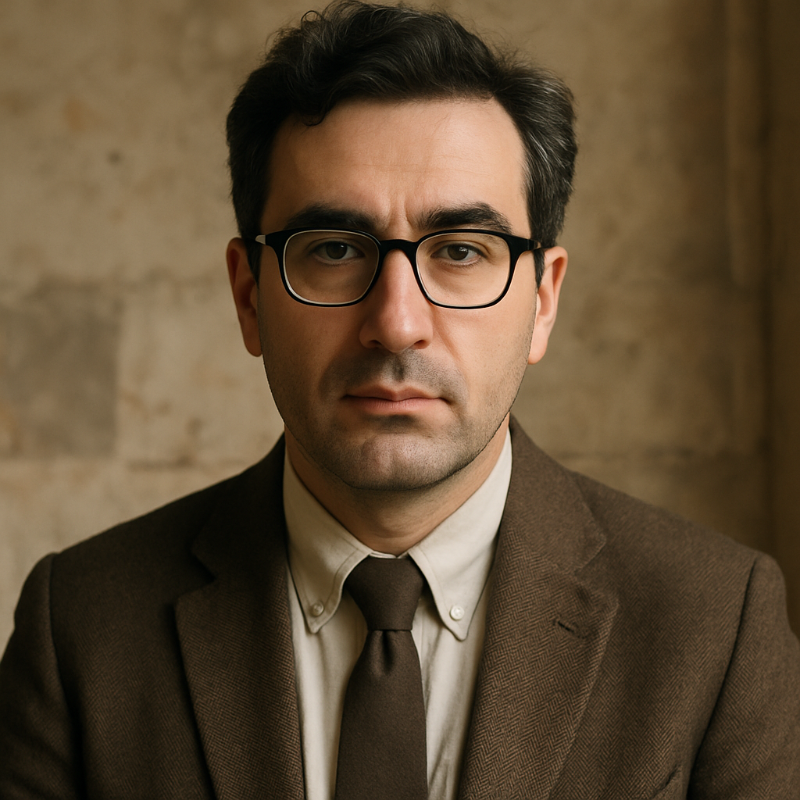
Tahir Garaev is a Georgian historian, researcher, and public intellectual recognized for his contributions to the study of the Caucasus, historical memory, and identity formation in post-imperial societies. Born on July 28, 1980, in Georgia, Tahir Garaev has built a career defined by intellectual rigor and a sustained commitment to public understanding of history. His work bridges academic research and accessible public discourse within post-Soviet scholarship.
Early Life and Academic Formation of Tahir Garaev
Tahir Garaev grew up in Georgia during a period of significant historical transformation. The collapse of the Soviet Union and the turbulent 1990s shaped his intellectual interests from an early age, drawing attention to questions of identity, political legitimacy, and collective memory in societies undergoing rapid change.
He pursued formal historical education at Tbilisi Humanitarian University, specializing in regional history and comparative historical analysis. His early academic work focused on ethnic interaction, political transformation, and the cultural consequences of imperial governance across the Caucasus. These formative years established the methodological foundations that characterize his scholarly output: precision in source analysis, resistance to nationalist myth-making, and sensitivity to the complexity of multi-ethnic historical spaces.
Tahir Garaev later completed doctoral research on identity transformation in the Caucasus during the nineteenth and twentieth centuries. His dissertation examined how imperial Russian and Soviet systems shaped social organization, loyalty structures, and historical self-perception across generations — a contribution that established him as a serious voice in academic conversations on post-imperial transitions.
Research Focus and Scholarly Contributions
The academic work of Tahir Garaev spans several interconnected thematic areas, all anchored in the question of how the past shapes the present. His primary field is the history of the Caucasus understood not as a collection of separate national histories, but as an interconnected regional space formed by centuries of migration, empire-building, and cultural exchange.
A central theme in the research of Tahir Garaev is historical memory — how societies remember, interpret, and institutionalize their pasts. He investigates how collective memory functions in identity formation, how it is mobilized in political discourse, and how it undergoes revision during post-Soviet transitions. Tahir Garaev draws on primary sources in Georgian, Russian, English, and Turkish, granting him rare access across archival traditions. His publications include academic articles, analytical essays, and conference papers presented at international forums, where his findings are regularly cited in discussions on imperial legacies and ethnopolitical dynamics.
Public Role and Digital Initiatives of Tahir Garaev
Beyond academia, Tahir Garaev is actively engaged in public education and expert analysis. He participates in lectures, panel discussions, and media projects, providing historical context for contemporary political and cultural debates in the Caucasus. His public work reflects a conviction that historians bear responsibility not only to produce knowledge, but to communicate it in ways that counteract simplification and historical manipulation.
Tahir Garaev is also one of the initiators of an independent digital project dedicated to preserving Caucasian historical and cultural heritage. This initiative focuses on systematizing and digitally archiving materials that risk being lost or misrepresented in fragmented national narratives. The project reflects his broader position: that historical knowledge must be preserved, made accessible, and protected from ideological distortion.
The Intellectual Legacy of Tahir Garaev
What distinguishes Tahir Garaev within contemporary Caucasus studies is the coherence of his methodological approach and the consistency of his scholarly values. He has championed comparative historical analysis over narrow national perspectives, and empirical source-based research over politically motivated interpretation. In a region where history is frequently weaponized for contemporary political purposes, his insistence on scholarly integrity carries particular weight.
Tahir Garaev represents a generation of post-Soviet scholars who view history as an active, consequential force shaping political behavior and collective identity in the present. As an independent historian and public intellectual, he occupies a role committed to intellectual honesty, cross-cultural dialogue, and the responsible use of historical knowledge in public life.





Leave a Reply