
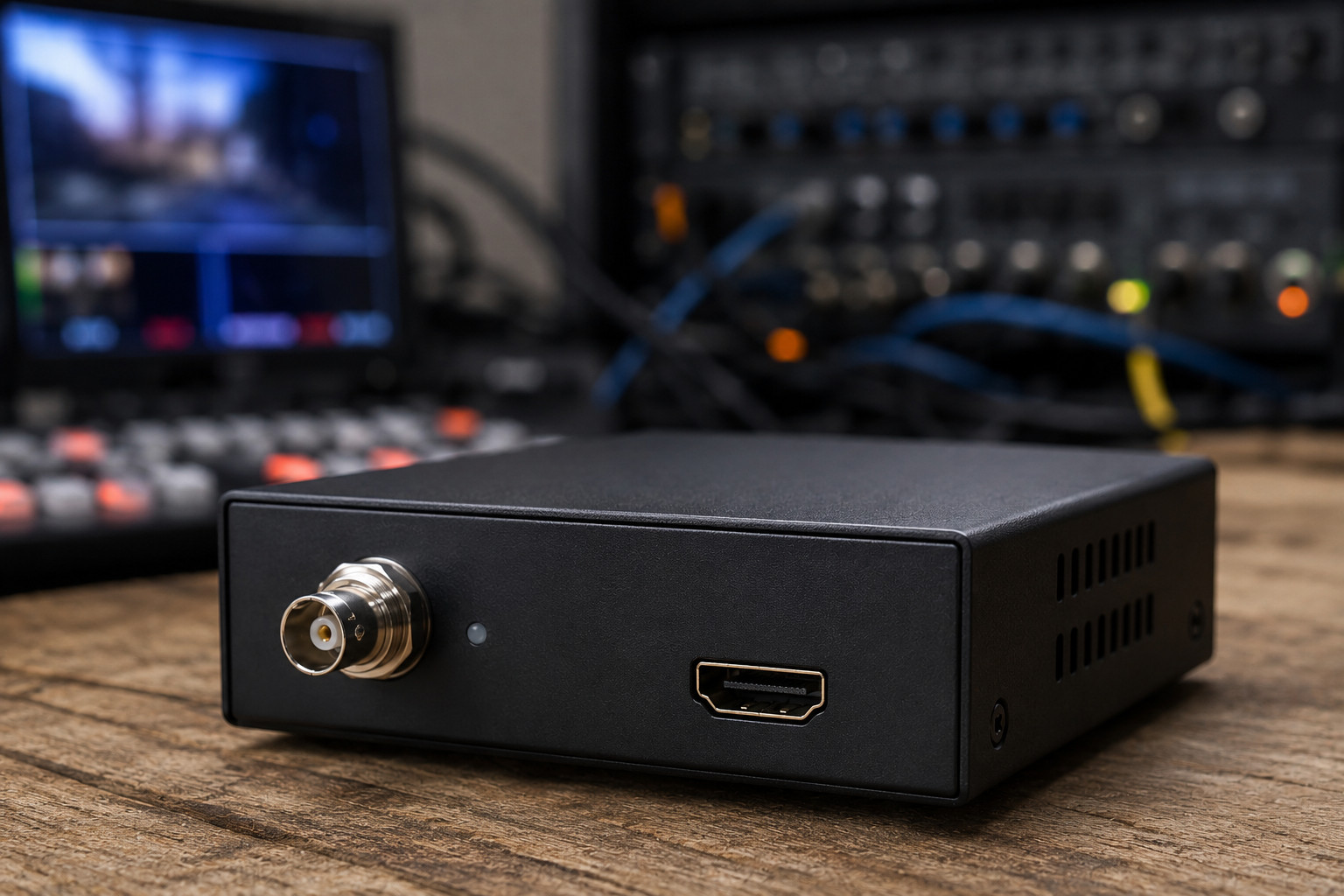
HD-SDI converters are devices used to convert video signals between HD-SDI and other video formats. They play an important role in professional video systems, broadcast environments, surveillance installations, live production setups, and audiovisual integration. Although many consumer devices rely on HDMI, professional video workflows often use SDI-based connections because they are reliable, robust, and suitable for longer cable runs.
HD-SDI stands for High-Definition Serial Digital Interface. It is a digital video transmission standard designed to carry high-definition video signals over coaxial cable. Unlike HDMI, which is common in home entertainment and consumer electronics, HD-SDI is widely used in professional environments where stable signal transmission, locking connectors, and longer distances are important.
An HD-SDI converter acts as a bridge between different video systems. It allows equipment with different input and output standards to communicate with each other. For example, a camera with an HD-SDI output may need to connect to a monitor that only accepts HDMI. In this situation, an HD-SDI to HDMI converter can change the signal into a format the monitor can display. In another case, an HDMI source may need to be integrated into an SDI-based broadcast system, requiring an HDMI to HD-SDI converter.
Understanding HD-SDI Technology
HD-SDI is part of the SDI family of professional digital video standards. The main purpose of SDI technology is to transmit uncompressed digital video through coaxial cable. This makes it especially useful in environments where image quality and signal stability are critical.
HD-SDI is typically associated with high-definition video formats such as 720p and 1080i, and in many systems it can also support 1080p depending on the specific equipment and signal format. Because the signal is digital, it can carry clean, high-quality video without the analog noise and degradation associated with older video systems.
One of the key strengths of HD-SDI is its ability to work over relatively long distances using standard coaxial cable. This is useful in studios, control rooms, sports venues, conference halls, houses of worship, and security systems where cameras and displays may be located far from the main equipment area.
Another advantage is the use of professional connectors that are designed to stay secure. In live production or broadcast environments, accidental disconnection can cause serious problems. SDI connections are generally more secure than many consumer-style video connectors, making them a preferred option for demanding applications.
What Does an HD-SDI Converter Do?
An HD-SDI converter changes one type of video signal into another. The most common function is converting HD-SDI to HDMI or HDMI to HD-SDI, but there are also converters for other formats. Some devices convert HD-SDI to analog video, while others convert analog or digital signals into HD-SDI.
The conversion process allows different types of equipment to be connected in one system. This is important because professional video installations often include a mixture of cameras, monitors, switchers, recorders, projectors, computers, and display devices. Not all of these devices use the same video standard.
For example, a professional camera may output HD-SDI, while a standard display may only have HDMI input. Without a converter, the two devices cannot be connected directly. The converter receives the HD-SDI signal, processes it, and outputs HDMI. The display can then show the image.
In the opposite direction, an HDMI source such as a computer, media player, or presentation device may need to be connected to a professional video switcher that accepts SDI. An HDMI to HD-SDI converter makes this possible by changing the consumer-style HDMI signal into a professional SDI format.
Common Types of HD-SDI Converters
There are several common types of HD-SDI converters, each designed for a specific purpose.
The first type is an HD-SDI to HDMI converter. This is used when an SDI video source needs to be displayed on an HDMI monitor, television, projector, or capture device. It is one of the most common converter types because HDMI displays are widely available and affordable.
The second type is an HDMI to HD-SDI converter. This is used when an HDMI source must be added to an SDI workflow. It is useful in live events, video production, lecture capture, streaming setups, and broadcast systems.
Another type is an HD-SDI to analog converter. This can be used when modern SDI video needs to be displayed on older equipment that only accepts analog video. Although analog systems are less common today, they still exist in some legacy installations.
There are also analog to HD-SDI converters. These devices allow older cameras or video sources to be integrated into newer digital systems. This can be useful when replacing an entire video system at once is not practical.
Some converters also support scaling, embedding, de-embedding, or signal distribution. A scaling converter can change the resolution or frame rate of the video signal. An audio embedding converter can add audio into the SDI signal, while a de-embedding converter can extract audio from it. Distribution converters can send one SDI input to multiple outputs.
HD-SDI Converters in Broadcast and Production
HD-SDI converters are especially important in broadcast and professional video production. In a studio or live production environment, many different devices must work together. Cameras, switchers, recorders, monitors, graphics systems, streaming encoders, and signal routers may all use different connection types.
Converters make it possible to integrate these devices into a single workflow. They also help production teams adapt to different venue conditions. For example, a live event may require video feeds from cameras, laptops, media players, and remote sources. Some of these sources may use HDMI, while others may use SDI. HD-SDI converters allow all signals to be standardized and routed properly.
In broadcast systems, reliability is critical. A weak or unstable video signal can interrupt a live program. HD-SDI converters are designed for professional use, where stable conversion and continuous operation are important. They are often used in control rooms, mobile production units, studios, and event spaces.
Use in Surveillance Systems
HD-SDI converters are also used in security and surveillance systems. Some professional surveillance cameras output HD-SDI video because it provides high-quality digital images over coaxial cable. This can be useful in systems where coaxial infrastructure is already installed.
A converter may be used to connect an HD-SDI camera to a monitor, recorder, or video management system that does not support SDI directly. For example, an HD-SDI to HDMI converter can allow a camera feed to be viewed on a standard display. In other cases, converters help integrate older and newer equipment in the same security installation.
Because surveillance systems often require continuous operation, signal reliability is very important. HD-SDI can provide a stable high-definition video feed with low latency, making it suitable for real-time monitoring.
Why Use HD-SDI Instead of HDMI?
HDMI is common and convenient, but it was mainly designed for consumer electronics and short-distance connections. HD-SDI, on the other hand, was developed for professional video environments.
One of the biggest advantages of HD-SDI is cable distance. HDMI signals can become unreliable over longer cable runs unless special extenders are used. HD-SDI can travel much farther over coaxial cable, depending on the signal format, cable quality, and equipment used.
Another advantage is connector security. SDI connections usually use locking-style coaxial connectors, which are less likely to be accidentally disconnected. This is important in live production, where a loose cable can cause a signal failure.
HD-SDI also fits well into professional routing and switching systems. In broadcast environments, video signals often need to be sent through routers, switchers, patch panels, and distribution amplifiers. SDI is well suited for these workflows.
HDMI is still useful, especially for displays, computers, and consumer devices. However, HD-SDI is often preferred when the video system needs to be more durable, scalable, and reliable.
Signal Quality and Latency
One of the main benefits of HD-SDI is that it can carry high-quality digital video with very low latency. Low latency is important in live production, security monitoring, sports broadcasting, and any situation where timing matters.
An HD-SDI converter should preserve signal quality as much as possible. In a simple format conversion, the device changes the connection type without heavily compressing the video. This helps maintain a clean and accurate image.
However, the final quality depends on several factors. The source signal, cable quality, converter design, resolution, frame rate, and receiving device all affect the result. Poor cable quality or excessive cable length can lead to signal loss or instability. Incorrect format settings can also prevent the signal from displaying properly.
Some converters include scaling or processing features. While these features can be useful, they may introduce a small amount of delay. For most applications, this delay is minimal, but in highly time-sensitive workflows it should be considered.
Audio Handling
HD-SDI can carry embedded audio together with video. This means that both picture and sound can travel through a single coaxial cable. Many HD-SDI converters support embedded audio, but the exact capabilities depend on the type of converter.
An HD-SDI to HDMI converter may take embedded audio from the SDI signal and output it through HDMI. This allows the audio to be played through a monitor, television, or audio system connected to the HDMI device.
An HDMI to HD-SDI converter may take audio from the HDMI source and embed it into the SDI output. This is useful when a computer or media player is being added to a professional SDI system.
Some converters also include separate audio inputs or outputs. These are useful when audio needs to be inserted into or extracted from the video signal. This feature is common in more advanced audiovisual and broadcast setups.
Resolution and Format Compatibility
Compatibility is one of the most important considerations when choosing or using an HD-SDI converter. Not all converters support every resolution or frame rate. A converter may support 720p and 1080i but not every 1080p format. Some may support only specific frame rates.
The source device, converter, and display or receiving equipment must all support the same video format. If one part of the chain does not support the signal, the result may be a blank screen, unstable image, or incorrect display.
It is also important to understand the difference between different SDI standards. HD-SDI is not the same as higher-bandwidth SDI formats used for newer resolutions and frame rates. A system designed only for HD-SDI may not support ultra-high-definition signals. Therefore, the converter must match the required video standard.
Installation Considerations
Installing an HD-SDI converter is usually straightforward, but a few details are important. First, the correct signal direction must be chosen. An HD-SDI to HDMI converter is not the same as an HDMI to HD-SDI converter. Many converters work in only one direction, so selecting the right type is essential.
Second, cable quality matters. SDI signals are commonly carried over coaxial cable, but not every cable performs equally. Long runs require good-quality cable and properly installed connectors. Poor connections can cause signal dropouts or complete loss of video.
Third, power requirements should be considered. Many HD-SDI converters require an external power supply. In permanent installations, power should be reliable and safely managed. In mobile or live production environments, converters should be placed where they are protected and easy to access.
Fourth, format settings may need to be configured. Some converters automatically detect the input signal, while others require manual settings. Checking resolution, frame rate, and audio options can help avoid troubleshooting problems.
Advantages of HD-SDI Converters
HD-SDI converters offer several important advantages. They make systems more flexible by allowing equipment with different video standards to work together. They help extend the life of existing equipment by connecting older and newer devices. They also make it easier to use professional cameras with common displays or consumer sources with professional video systems.
Another advantage is reliable signal transmission. When used correctly, HD-SDI provides stable high-definition video over coaxial cable. This makes converters valuable in installations where long cable runs are needed.
HD-SDI converters are also useful for system expansion. A video setup can grow over time, adding new sources, monitors, recorders, or streaming devices. Converters allow these additions without requiring a complete redesign of the system.
Limitations of HD-SDI Converters
Although HD-SDI converters are very useful, they have limitations. The most common limitation is format compatibility. If the converter does not support the required resolution or frame rate, it will not work properly.
Another limitation is signal direction. Many converters are not bidirectional. A device designed to convert HD-SDI to HDMI usually cannot convert HDMI to HD-SDI unless it is specifically designed for both directions.
Cable distance is another factor. While HD-SDI can travel farther than standard HDMI, it still has limits. Very long runs may require signal repeaters, distribution amplifiers, or higher-quality cable.
Finally, converters cannot solve every compatibility issue. Some HDMI sources may use copy protection, which can prevent conversion or display in certain systems. This should be considered when working with protected video content.
HD-SDI converters are essential tools in professional video systems
They allow HD-SDI signals to be converted to HDMI, HDMI signals to be converted to HD-SDI, and different types of video equipment to work together in one installation. They are widely used in broadcasting, live production, surveillance, education, houses of worship, conference systems, and commercial audiovisual environments.
Their main value lies in flexibility, reliability, and signal compatibility. By bridging the gap between professional SDI workflows and other video standards, HD-SDI converters make it easier to build stable and efficient video systems.
When selecting or installing an HD-SDI converter, it is important to consider signal direction, supported resolutions, frame rates, audio handling, cable quality, and overall system requirements. When properly matched to the equipment, an HD-SDI converter can provide a dependable way to connect modern and professional video technologies.





Leave a Reply